
Apple Pay Casinos UK — Fast Mobile Deposits & Withdrawals
 Available in GB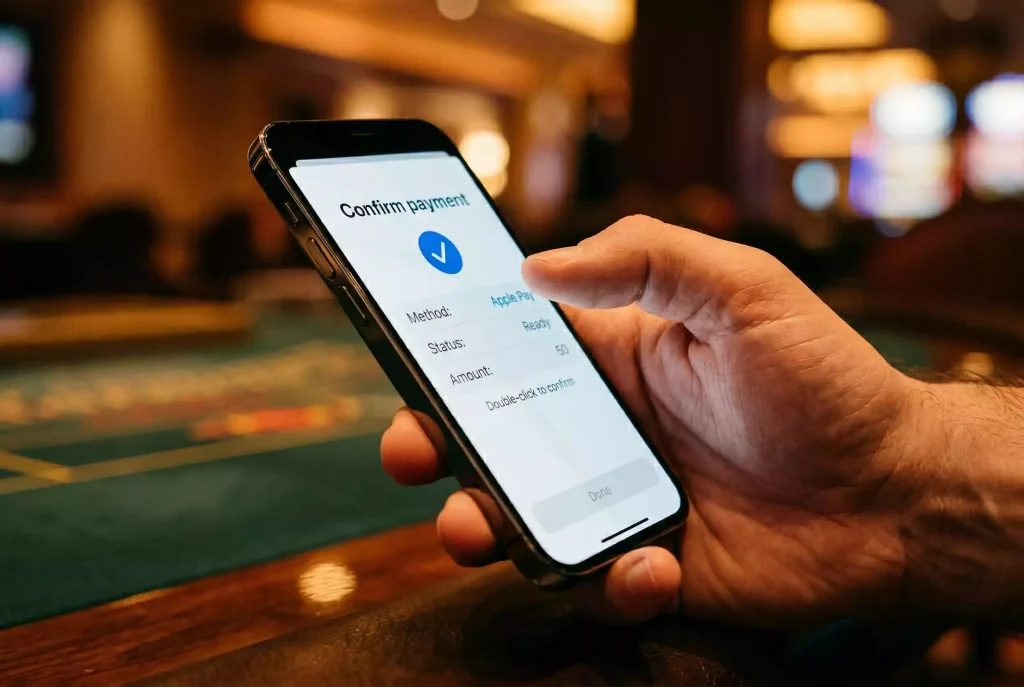
Apple Pay at UK Casinos — Tap, Deposit, Play
Apple Pay has moved from a contactless shopping convenience to a genuine payment option at a growing number of UKGC-licensed casinos. The appeal is immediate and practical: authenticate with Face ID or Touch ID, confirm the amount, and the deposit lands in your casino account within seconds. No typing card numbers on a small screen, no navigating to a third-party payment page, no remembering login credentials for a separate e-wallet. The entire transaction happens inside the interaction model that iPhone and iPad users already know from buying a coffee or tapping through the Tube.
For UK casino players, Apple Pay represents the fastest route from decision to deposit. The friction between “I want to play” and “I’m playing” shrinks to a biometric scan and a tap. That speed is a genuine advantage when you’re topping up mid-session on mobile or responding to a time-limited bonus offer. It’s also, worth noting, a feature that demands self-awareness — the same frictionlessness that makes Apple Pay convenient also removes the pause that typing in card details naturally provides. Convenience and impulse are close neighbours.
The number of UK casinos supporting Apple Pay has grown steadily, though it’s not yet universal. Larger operators with dedicated mobile apps tend to integrate it as a standard option. Smaller or newer sites may not have completed the technical integration. Checking whether Apple Pay is listed in the casino’s banking section before registering is a two-minute step that avoids discovering the limitation after you’ve committed to the platform.
Apple Pay at UK casinos is exactly what it sounds like: tap, deposit, play. The simplicity is the product.
Recommended online casinos
- BritsinoBonus: Welcome Package – Get your £2,200 + 2,000 FS · Payout speed: 1-3 business days
- ChanzeBonus: Slots Welcome Bonus #1 200% up to €500 · Payout speed: 1-3 business days
- SlotoSportBonus: 500% up to £ 10 200+ 777 FS · Payout speed: 1-3 business days
- BeOnBetBonus: 100% up to €500 + 100 FS · Payout speed: 1-3 business days
- SpinFormulaBonus: 550% Up To £15,000 + 550 FS · Payout speed: 1-3 business days
- x3betBonus: Welcome Pack 100% Up to £1.000 + 200 Free Spins · Payout speed: 1-3 business days
How Apple Pay Casino Transactions Work
An Apple Pay deposit at a UK casino uses the debit card stored in your iPhone’s Wallet app as the funding source. When you select Apple Pay in the casino’s cashier and authenticate the transaction, Apple Pay generates a tokenised version of your card details — a unique device account number rather than your actual card number — and transmits it to the casino’s payment processor. The processor handles it as a card-not-present transaction, the funds are debited from your bank account through the card network, and the deposit appears in your casino balance instantly.
The tokenisation layer is the security advantage over entering card details directly. The casino never receives or stores your actual card number. If the casino’s systems were compromised, the token is useless outside the context of that specific device and transaction. This isn’t theoretical security theatre — it’s a genuine architectural protection that reduces your exposure compared to typing your Visa digits into a web form.
Deposit limits for Apple Pay transactions are typically determined by the casino rather than by Apple. Most operators set the same minimum and maximum deposit amounts for Apple Pay as they do for standard debit card deposits — commonly £10 minimum, with maximum limits ranging from £5,000 to £20,000 per transaction depending on the operator’s risk policies. Apple’s own transaction limits may also apply, though these are generally high enough that they don’t interfere with typical casino deposit amounts.
Withdrawals via Apple Pay are where the picture becomes less straightforward. While the number of casinos supporting Apple Pay withdrawals has increased, it’s not as widely available as deposit support. Many operators that accept Apple Pay deposits will route withdrawals back to the underlying debit card rather than through the Apple Pay interface itself. The practical difference is minimal — the funds go to the same bank account either way — but the speed and experience may differ. A withdrawal processed through Apple Pay can arrive faster than a standard card withdrawal at some operators, though this depends on the casino’s payment processor and the card issuer’s settlement speed.
The transaction process at the bank level is identical to a debit card payment. Your bank statement will show the casino’s name as the merchant, not Apple Pay. If you’re using Apple Pay specifically for the privacy benefit of keeping casino transactions off your card record, that advantage doesn’t exist — the bank sees the same information regardless of whether you tapped your phone or typed your card number.
Limitations and Workarounds
Apple Pay’s casino limitations fall into three categories: platform exclusivity, withdrawal availability, and bonus eligibility. Each is manageable, but none should be discovered mid-session.
Platform exclusivity is the most obvious constraint. Apple Pay works only on Apple devices — iPhone, iPad, Apple Watch, and Mac with Touch ID or Apple Pay in Safari. If you play on an Android phone, a Windows laptop, or any non-Apple hardware, the option doesn’t exist. This isn’t a casino limitation; it’s an Apple ecosystem boundary. Google Pay provides a functionally equivalent experience on Android devices, and many of the same casinos that support Apple Pay also support Google Pay, though the two aren’t interchangeable within a single session.
Withdrawal support, as noted, is inconsistent. If you deposit with Apple Pay and the casino doesn’t support Apple Pay withdrawals, your cashout will default to the underlying debit card. The funds reach the same destination, but the processing time may follow the standard card withdrawal timeline of one to three business days rather than any accelerated Apple Pay channel. Before depositing, confirm whether the casino processes withdrawals through Apple Pay or falls back to the card.
Bonus eligibility can be affected by Apple Pay’s classification as a payment method. Some UK casinos treat Apple Pay deposits identically to debit card deposits for bonus purposes, meaning full welcome offer eligibility. Others classify Apple Pay under their e-wallet or mobile payment policy, which may carry reduced bonus eligibility or exclusion from certain promotions. The categorisation varies by operator and isn’t always consistent with logic — Apple Pay is funded by a debit card, but the casino’s system may not recognise it as one. Check the bonus terms for “excluded payment methods” before making your qualifying deposit.
Each of these limitations has a workaround. No Apple device? Use Google Pay or a debit card. No Apple Pay withdrawal support? The card handles it. Bonus exclusion? Deposit the qualifying amount via debit card, then switch to Apple Pay for subsequent top-ups. None of these require significant effort, but all require the awareness to check before committing.
When Convenience Meets Compliance
Apple Pay’s growth in UK casino banking reflects a broader shift in how players expect to interact with financial transactions on mobile. The demand is for speed, security, and minimal friction — and Apple Pay delivers all three within its ecosystem. The compliance layer underneath is the same as any other UKGC-regulated payment method: KYC verification applies to your first withdrawal regardless of how you deposited, responsible gambling tools function independently of your payment choice, and your funds are held in accordance with the operator’s licence conditions.
The convenience of Apple Pay doesn’t bypass any regulatory protection, and it shouldn’t. What it does is remove the procedural friction from the deposit step — the step that benefits most from speed and least from delay. The compliance steps that genuinely protect players — identity verification, deposit limits, self-exclusion — sit at a different layer of the experience and remain fully in place regardless of whether you paid with a fingerprint or a sixteen-digit card number.
Where Apple Pay fits in the broader payment landscape is as a convenience enhancement rather than a fundamental change. It’s faster than typing card details, more private than sharing your card number directly with the casino, and integrated seamlessly into the mobile experience that most UK players already inhabit. When convenience meets compliance cleanly — as it does here — the result is a better payment experience without any sacrifice in player protection. That’s a combination worth choosing when it’s available.