Online Baccarat UK — Rules, Strategy & Live Tables
Best Non GamStop Casino UK 2026
Loading...
Baccarat Online — The Simplest Table Game in the Casino
Baccarat is the table game that requires the least from you and returns some of the best odds in the casino. There are no decisions to make during the hand. No strategy charts to memorise. No skill gap between a first-time player and someone with twenty years of experience. You place your bet on one of three outcomes — Player, Banker, or Tie — the cards are dealt according to fixed rules, and the result is determined without any further input from you. The entire game, from bet to outcome, takes under a minute.
This simplicity is precisely why baccarat holds a distinctive position in the UK online casino market. It offers a house edge on the Banker bet of approximately 1.06% — lower than European roulette’s 2.70%, dramatically lower than any slot, and competitive with basic strategy blackjack — without requiring the player to learn anything beyond which bet to place. For players who want favourable odds without the time investment of studying optimal play, baccarat delivers the mathematical efficiency of a skill game through a format that requires no skill at all.
At UK casinos, baccarat is available in both RNG (software-dealt) and live dealer formats, with live baccarat drawing the majority of player traffic. The game’s popularity in Asian gambling markets has driven substantial investment in live baccarat tables, resulting in a wider variety of table types, bet ranges, and side bet options than most UK players might expect from a game they’ve potentially overlooked.
Punto Banco Rules and Betting Options
The version of baccarat played at virtually every UK casino is Punto Banco — a fully automated dealing format where the rules dictate every action. Neither the Player (“Punto”) nor the Banker (“Banco”) hand involves any player decision-making. The draw rules are fixed, and the dealer or software follows them mechanically. Understanding these rules isn’t necessary to play — the game runs itself — but knowing them removes the mystery from a process that can seem opaque if you’re watching for the first time.
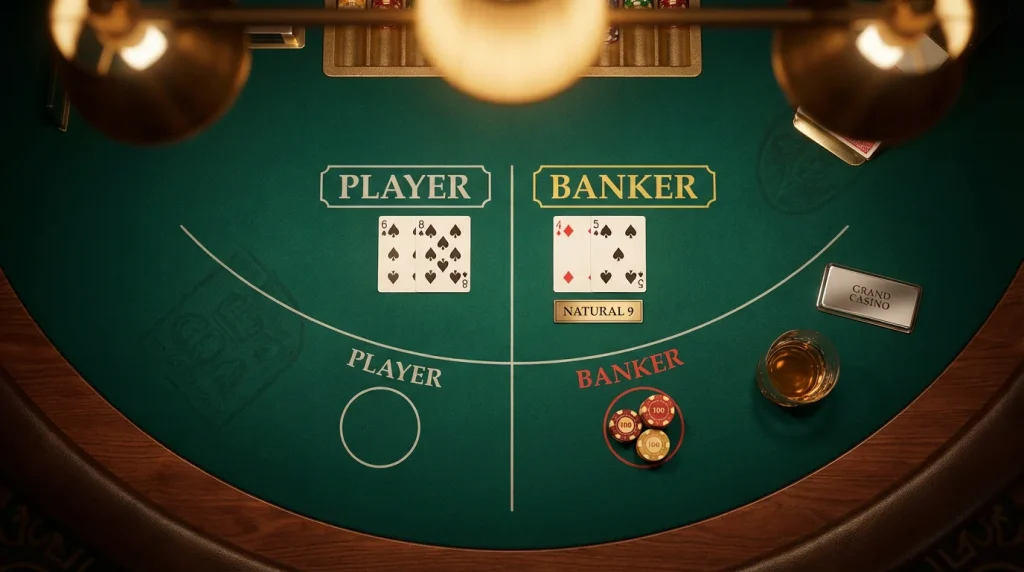
Two hands are dealt: one for Player and one for Banker. Each hand receives two initial cards. Card values differ from blackjack: numbered cards 2 through 9 are worth their face value, tens and face cards are worth zero, and aces count as one. The hand value is the last digit of the total of all cards. A hand of 7 and 5, totalling 12, has a value of 2. A hand of 8 and 3, totalling 11, has a value of 1. The best possible hand is a “natural” — an 8 or 9 from the first two cards.
If either hand is a natural 8 or 9, the round ends immediately and the higher natural wins. If neither hand is a natural, the draw rules engage. The Player hand draws a third card if its total is 0 through 5, and stands on 6 or 7. The Banker hand’s drawing rule is more complex, depending on both its own total and the value of the Player’s third card. These conditional rules are entirely automatic — the dealer or software applies them without player intervention — so memorising them is optional. What matters is that the rules are fixed and produce consistent, auditable outcomes.
Three primary bets are available. The Banker bet carries a house edge of 1.06% after accounting for the 5% commission charged on winning Banker bets. The Player bet has a house edge of 1.24%, with no commission. The Tie bet — wagering that both hands will finish with the same value — pays 8 to 1 or 9 to 1 depending on the table, but carries a house edge of approximately 14.4%. The maths is unambiguous: the Banker bet is the statistically optimal choice for every round. The Tie bet is one of the worst-value wagers available at any table game.
Side bets are available at many live baccarat tables. Player Pair and Banker Pair bet that the first two cards dealt to either hand will be a matching pair. These pay 11 to 1 but carry house edges of around 10% to 11%. Other side bets vary by provider and include options like Big/Small (total cards dealt in the round), Perfect Pair, and various dragon bonus bets. All side bets carry significantly higher house edges than the three main wagers. They add variety and potential excitement to individual rounds, but over volume, they increase the cost of play substantially.
Live Baccarat vs RNG — Where the Action Is
Live baccarat has become the dominant format for the game at UK casinos, driven by investment from Evolution, Pragmatic Play Live, and Playtech. The live format adds what software-dealt baccarat lacks: the visual confirmation of cards being drawn from a physical shoe, the pace set by a real dealer, and the ritual elements — the squeeze, the reveal — that baccarat has historically relied on for its atmosphere.
Evolution’s live baccarat offering includes standard tables, speed baccarat (with a reduced dealing window for faster play), and no-commission baccarat (where the 5% Banker commission is replaced by a rule that Banker wins on a total of 6 pay half the normal amount). Lightning Baccarat adds random multipliers to winning hands, with potential payouts up to 512x on individual bets — a high-volatility variant that borrows its multiplier mechanic from Lightning Roulette. Each variant alters the presentation and, in some cases, the payout structure, but the core Punto Banco rules remain the foundation.
RNG baccarat plays faster, accepts lower minimum bets — often £0.50 or £1 per hand — and is available without waiting for a seat or competing with other players for table space. For players learning the game, testing bet patterns, or simply wanting quick rounds at low stakes, RNG baccarat provides an efficient no-pressure environment. The mathematical rules and house edge are identical to live baccarat, though the absence of the physical dealing process means you’re relying entirely on the certified random number generator for outcomes.
The choice mirrors the live-versus-RNG split in blackjack and roulette: live for atmosphere, social engagement, and the trust that comes from watching a physical process; RNG for speed, lower stakes, and privacy. Both deliver the same mathematical game. The format determines the experience around it.
The Game That Rewards Patience Over Strategy
Baccarat’s value proposition is unusual in a casino context. It asks nothing of you — no study, no practice, no decision-making under pressure — and in return it offers one of the lowest house edges available. The Banker bet at 1.06% is mathematically superior to almost every other wager in the casino, and accessing it requires only the willingness to place the bet and wait for the outcome. Patience is rewarded because the low edge compounds favourably over time: the less the house takes per bet, the longer your bankroll survives, and the more entertainment value you extract from each pound deposited.
The trap in baccarat isn’t the game itself — it’s the side bets and the Tie wager that surround it. The core game is lean and efficient. The periphery is expensive. A player who bets exclusively on Banker and ignores everything else is playing one of the smartest games in the casino. A player who spreads bets across Tie, pairs, and dragon bonuses is paying five to ten times the house edge of the core game for marginal entertainment value. Discipline in baccarat isn’t about when to hit or stand — it’s about which bets to place and which to leave alone.
Baccarat rewards patience, not strategy, because there is no strategy to learn. The optimal play is known: bet Banker, skip the Tie, ignore the side bets, and let the 1.06% edge do as little damage as possible across your session. Everything beyond that is decoration. The simplest game in the casino is also one of the best, and the player who recognises that needs nothing more than a seat and a budget to access it.